
With recent market volatility, it is worth remembering that strong returns can sometimes encourage the wrong kind of behaviour, and broader sell-offs can too.
 |
Warren Buffett has often described the stock market as something like a church with a casino attached. The “church” represents long-term ownership in good businesses, disciplined investing, and patience. The “casino” represents short-term speculation, hype-driven trading, and the temptation to chase whatever has recently gone up the most. His point is especially relevant today. Many investors appear increasingly willing to take on short-term risk in the hope of quick gains. History suggests that this can work for a while, particularly when enthusiasm is high, but it can also reverse quickly, and recent market events are a great example of this. Stocks that rise primarily because of excitement, rather than strong business fundamentals, are often the most vulnerable when markets weaken. |
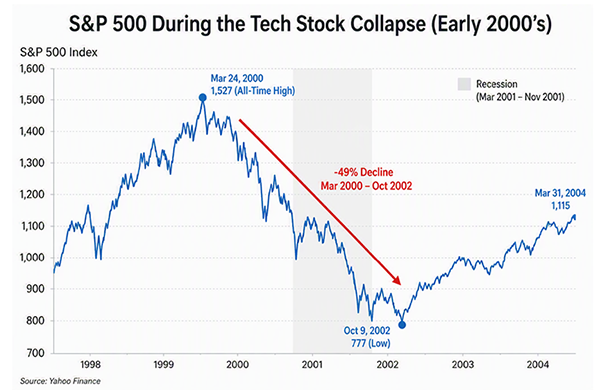
The dot-com period is another good example. Many technology companies saw their share prices rise dramatically, only to fall sharply when the market turned. In many cases, the underlying businesses were not strong enough to support the valuations investors had placed on them.
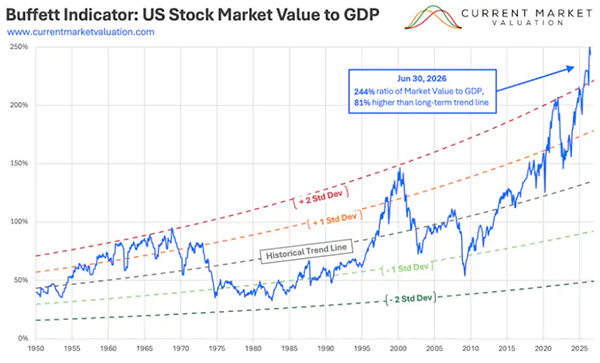
There are also broader valuation concerns in today’s market. One measure often associated with Buffett compares the total value of the U.S. stock market to the size of the U.S. economy. When that ratio becomes elevated, it can suggest that investors are paying high prices relative to the underlying economy. Today, even with the more recent price declines in the big AI players, that measure is sitting at historically high levels.
Source: Behaviour Gap
This is why valuation discipline remains important, even when we are focused on owning high-quality businesses. No single metric tells the whole story, but there are several useful tools we look at when assessing whether a business is reasonably priced. The price-to-earnings ratio compares a company’s share price to its earnings, and when it is high relative to peers or its own history, it can be a warning sign. EV/EBITDA is helpful because it looks at the value of the entire business relative to its operating earnings, which makes it useful when comparing companies with different debt levels or capital structures. The PEG ratio adjusts valuation for expected earnings growth, which is especially important for faster-growing companies where a high P/E ratio alone may not tell the full story. Price-to-sales and price-to-book ratios can also be useful, particularly when earnings are negative, unusually low, or unreliable, which is often the case with earlier-stage growth companies. A process where portfolio managers spend the time understanding the fundamental reasons why each business is worth owning and has proven to be resilient over different market cycles, is paramount to building long-term wealth. Ultimately, the best approach is to develop a thoughtful view of a company’s future revenue, earnings, and cash flow, and then compare that to what today’s stock price already appears to be assuming.
The recent volatility of the broader stock market and more specifically the technology sector doesn’t contradict this principal, rather reinforces the importance of disciplined business ownership. Anthropic (ANT:NAS) and its recent IPO, underscores how a speculative asset reacts much differently to a company more likely to trade on its fundamentals during these periods. Psychologically, it is normal for us to crave the “shiny new toy” but quickly jumping on a new theme often proves to open investors up to unforeseen risks, simply because too many variables remain unknown. We try to not swing at these pitches. Our focus remains on owning quality investments, maintaining proper diversification, managing risk, and avoiding the temptation to chase speculative areas of the market simply because of recent performance or positive speculation.
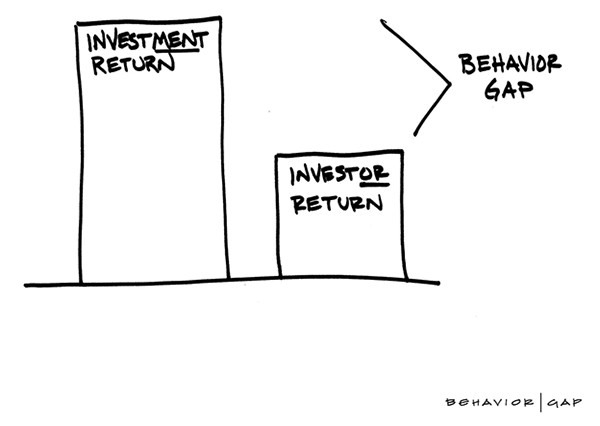
The chart below highlights another important lesson. There is often a meaningful difference between the return an investment delivers and the return investors experience. This difference, sometimes called the “behaviour gap,” is typically created by emotional decision-making. Investors often become more optimistic after prices have already risen and more fearful after markets decline, causing them to buy and sell at the wrong times. It is another reminder that long-term success is driven less by trying to predict the next market move and more by staying disciplined, focusing on quality investments, and following a consistent investment plan.
In periods like this, patience and process matter. Long-term investment success is rarely built by trying to win in the casino. It is built by staying grounded in fundamentals, valuation, and a clear plan.
Your CrossPoint Financial Team
